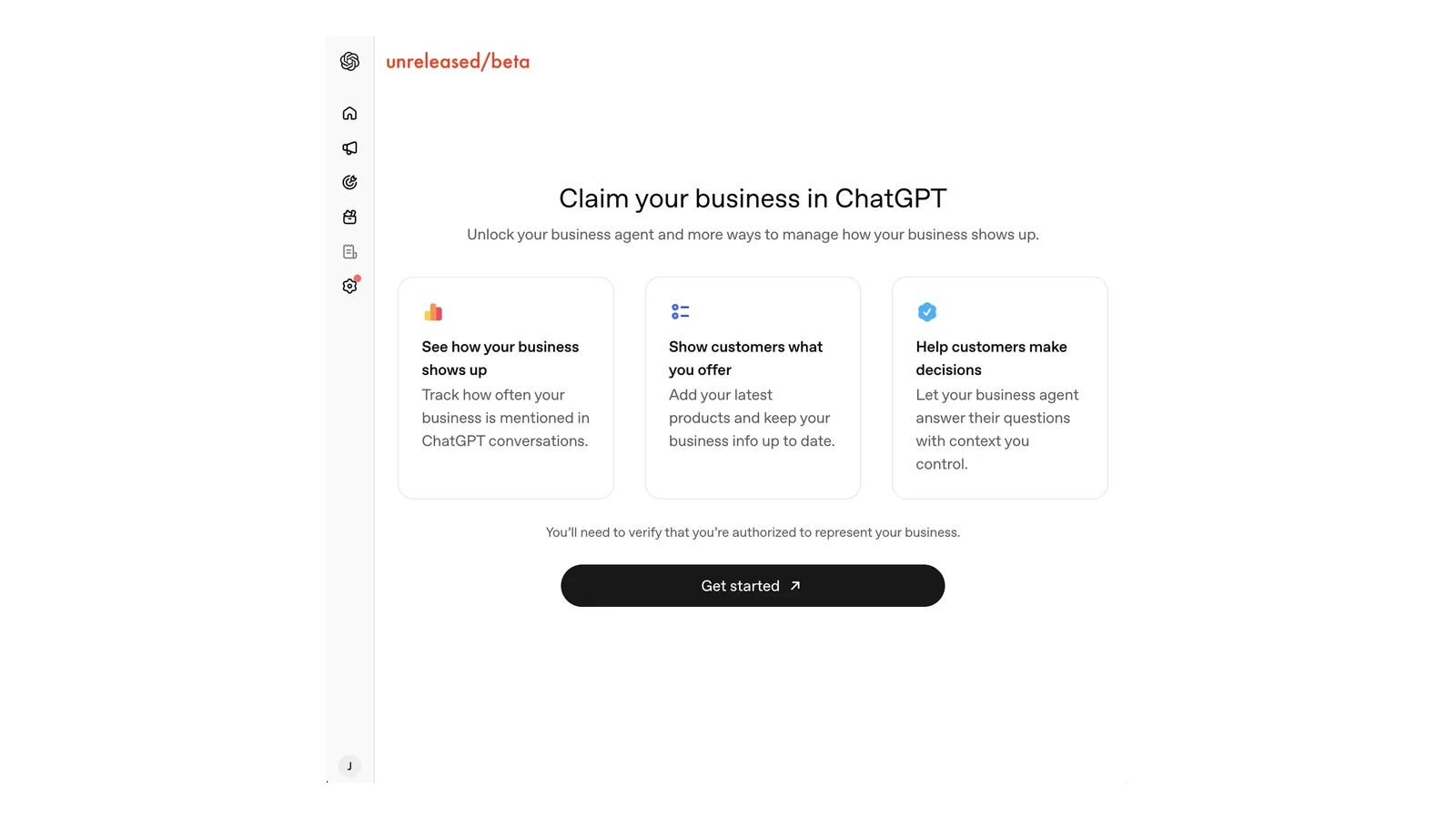
Image: Search Engine Roundtable (screenshot originally posted by Juozas Kaziukėnas on LinkedIn, 6 November 2026)
Here's the bit that matters.
OpenAI is testing a first-party analytics platform for ChatGPT. Daily counts of how often your business shows up in answers, and how many people click through to your site. Charted over time. From the company that runs the conversations.
That is not a nice-to-have profile claim. That is measurement of intent — demand expressed inside an artificial intelligence (AI) chat — moving from guesswork into a platform dashboard. For an intent marketer, that is huge.
I'll get the caveats out early: OpenAI has announced nothing. The feature is stamped unreleased/beta. Digiday's sources describe it; OpenAI declined to comment. Everything below treats it as a strong signal, not a ship date. But if it lands anything like the screenshot suggests, the game for how we prove and buy AI visibility changes.
What leaked
On 6 November 2026, Juozas Kaziukėnas — founder of Marketplace Pulse — posted a screenshot of an unreleased ChatGPT screen. Search Engine Roundtable and Search Engine Land covered it the same morning. Digiday followed with two separate sources, and noted OpenAI's no-comment.
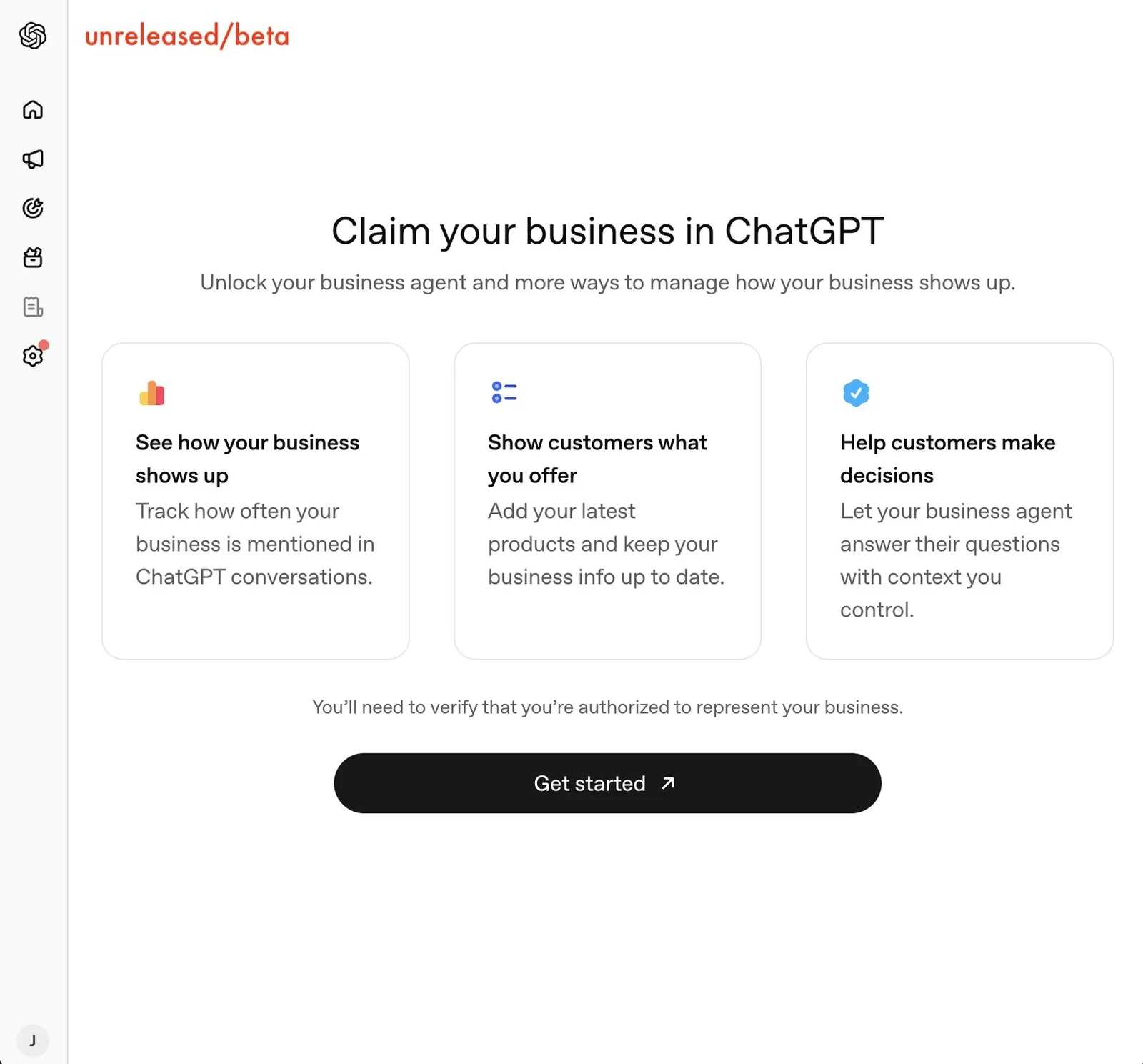
The banner is headed "Claim your business in ChatGPT". Three cards sit under it: track how often you are mentioned; keep products and business info current; let a business agent answer with context you control. Fine print: verify you are authorised to represent the business.
Juozas's more important line is about the analytics, not the claim button. He wrote that the tool measures impressions (times a business appeared in ChatGPT responses) and clicks (to the business website), tracked daily and shown as a chart. He first saw traces in August. It sits inside a larger Business Hub. Access needs verification — he cited connecting a Shopify store as one example.
Claiming the listing is the access mechanism. The product is the chart.
Why this is a watershed for intent marketing
Intent is the moment someone is in-market: asking, comparing, shortlisting, looking for a safe good decision. For twenty years that signal mostly lived in search queries, paid keywords and on-site behaviour. Search Console and Keyword Planner made it measurable, and whole industries of search engine optimisation (SEO) and paid search grew around those numbers.
Buyers have been shifting those same questions into ChatGPT, Perplexity, Gemini and the rest. "Best seven-seat SUV for a family." "Accounting software that won't fall over at month end." "Agencies that actually do performance, not decks." The intent is real. The measurement has been a mess: third-party tools sampling prompts at scale, founders screenshotting their own chats, or a shrug in the weekly pack.
First-party impressions and clicks from OpenAI would be different in kind. Not a modelled estimate of whether you might appear. A count from the platform of whether you did, and whether anyone followed the link. That is the Search Console moment for AI answers.
What follows measurement is predictable, because we have watched it before:
- Budgets follow the chart. Once ChatGPT visibility is a line next to organic search, someone will ask why it is flat — and what it would cost to move it.
- Attribution gets a new channel. ChatGPT referrals stop being a bucket of mystery "AI" traffic and become a number you can defend to finance.
- Content and product data get held to account. If mentions fall after a site change, or rise after you fix your facts, the chart will show it — even if it won't tell you which prompt drove the move.
- Paid and organic sit closer together. Digiday's read is that a daily visibility number creates demand for a paid lever next to the answer. Google's Business Profile and Search Console did the same job for ads sales years ago. Plausible. Not confirmed.
This is also where generative engine optimisation (GEO) — the craft of earning a place in AI answers — stops being a speculative line item and starts looking like a channel with a scoreboard.
What it will show — and what it won't
Honesty matters more than hype here.
Likely on the board (per Juozas and Digiday's sources): daily impressions, daily clicks, a trend chart, for businesses that have verified they represent the brand. Product and business info you can keep current. A business agent fed with context you control.
Explicitly off the board (Juozas): prompts, user data, competitor benchmarks or rankings. So you may learn that mentions dropped last Tuesday. You will not learn which questions stopped naming you, who took the slot, or whether the hit landed on commercial queries or brand queries.
That gap is why this still matters and why it does not retire your other tools. Search Console never told you the keyword in every impression for free forever either — and marketers still built empires on what it did show. First-party counts become the score. Prompt-tracking tools, citation analysis and good old qualitative checks stay the match footage.
Also off the board until OpenAI speaks: a launch date, pricing, markets, historical backfill, and any official name. "Search Console for ChatGPT" and "GPT Analytics" are our labels. Do not confuse this hub with OpenAI's Admin Console analytics for Enterprise and Edu, which measure how your staff use ChatGPT — a different product entirely.
Adjacent and already announced (useful context, not the same thing): Instant Checkout, the Agentic Commerce Protocol, product feeds, and Shopify Catalog feeding shopping results. Those are live commerce rails. The analytics hub is the missing measurement layer.
So what should marketers do now?
You don't rebuild the quarter around a screenshot. You get ready so that if the chart goes live, you are not starting at zero.
1. Baseline AI visibility while you still have to do it by hand.
List the ten to twenty questions your in-market buyers actually ask — category, comparison, "best for…", local variants. Run them through ChatGPT. Record whether you appear, who else does, and which sources get cited. Repeat monthly. When first-party numbers arrive, you own a before.
2. Segment ChatGPT referrals in your analytics.
If ChatGPT visits are buried inside "referral" or a generic AI bucket, you will have nothing to reconcile against OpenAI's click count. Give the channel its own view now.
3. Build content for buyer-intent questions, not for algorithms.
The questions above are the brief. Answer them clearly on pages a model can quote: comparisons, proof, pricing logic, who it is for, who it is not for. Intent-shaped content travels from Google to ChatGPT without a rewrite.
4. Keep entity and product data boringly accurate.
About page, product feed, structured data, Google Business Profile, any Wikipedia facts. The leaked hub literally invites you to keep products and business info up to date. Brands that look inconsistent across the open web get inconsistent answers. Fix the facts before you obsess over the claim button.
5. Decide who owns the claim.
When verification opens, someone has to click Get started and stay responsible for the agent and the data. Agencies and in-house teams should agree that before the invite lands — so the analytics start under the right account, not a scramble.
Bottom line
The story is not that OpenAI wants another business profile in the world. The story is that intent expressed inside ChatGPT is about to become measurable by the platform that hosts it.
Search Console did not invent search demand. It made search demand impossible to ignore. A ChatGPT analytics chart would do the same for AI conversations: turn "we think we show up" into a number on a Tuesday, sitting next to the rest of the marketing scoreboard.
OpenAI has not shipped it. Digiday's sources say it is real enough that the company was asked and declined to comment. Treat the leak as a signal. Treat the preparation as free optionality.
Intent was already moving into the chat window. Measurement is how budgets, teams and content finally follow.
Phil Ohren
CEO, Intender · Intent marketer
Book a Fresh Eyes Audit
Sources
- Juozas Kaziukėnas on LinkedIn (6 November 2026)
- Search Engine Roundtable (Barry Schwartz, 6 November 2026)
- Search Engine Land (Barry Schwartz, 6 November 2026)
- Digiday (Krystal Scanlon, 9 November 2026; OpenAI declined to comment)
- OpenAI: Buy it in ChatGPT (Instant Checkout — announced product, separate from the analytics hub)
- OpenAI: Powering product discovery in ChatGPT