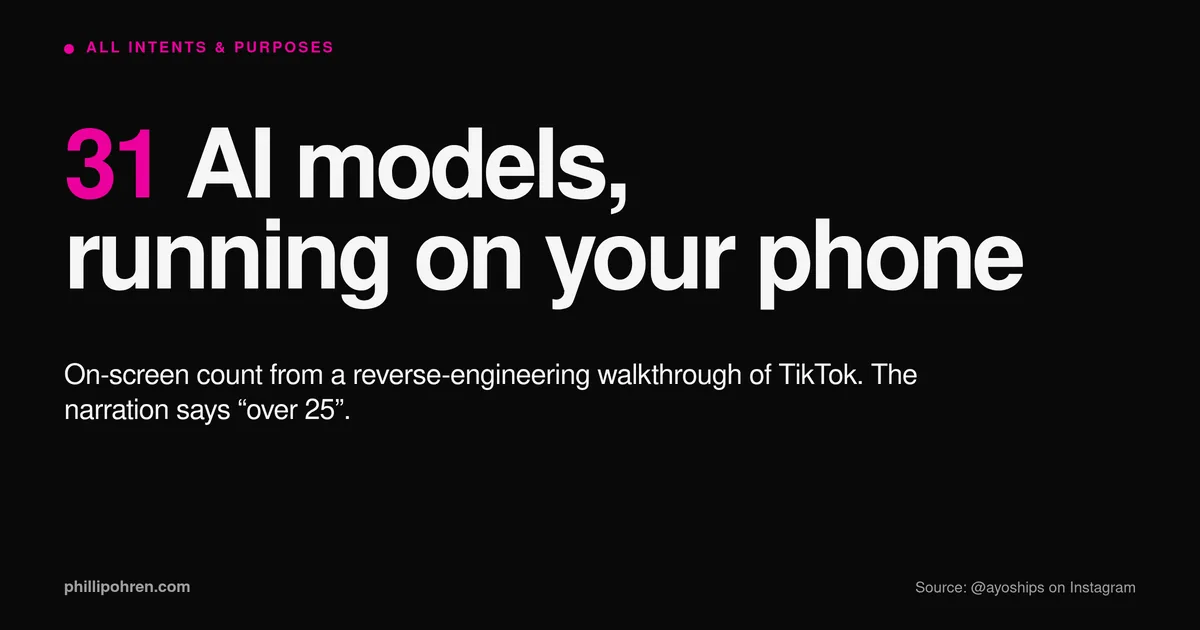
In early November 2026, Ayo Omolewa, who posts as @ayoships, published an Instagram reel he presented as a reverse-engineering walkthrough of TikTok. He said he had found more than 25 artificial intelligence (AI) models running on the phone — the on-screen count is 31 — to work out what will keep you scrolling.
Much of the scoring story he tells is not a secret. TikTok has published how For You uses prediction scores, and an internal briefing, "TikTok Algo 101", was confirmed as authentic to The New York Times in 2021. Some of the on-device detail, though, I cannot corroborate from those public sources. Here is the system in four steps, with the reel as attributed evidence and anything unconfirmed clearly flagged.
First, the servers score each video
Before a clip plays, TikTok's systems are already estimating how you will behave. In its introduction to the recommendation system, TikTok says it creates a prediction score — "an estimate of how likely you are to interact with" a video — and serves the highest-scoring clips to For You. Those predictions include the likelihood you will like, share, comment, skip, finish, favourite or follow, and "spend a certain amount of time viewing a video."
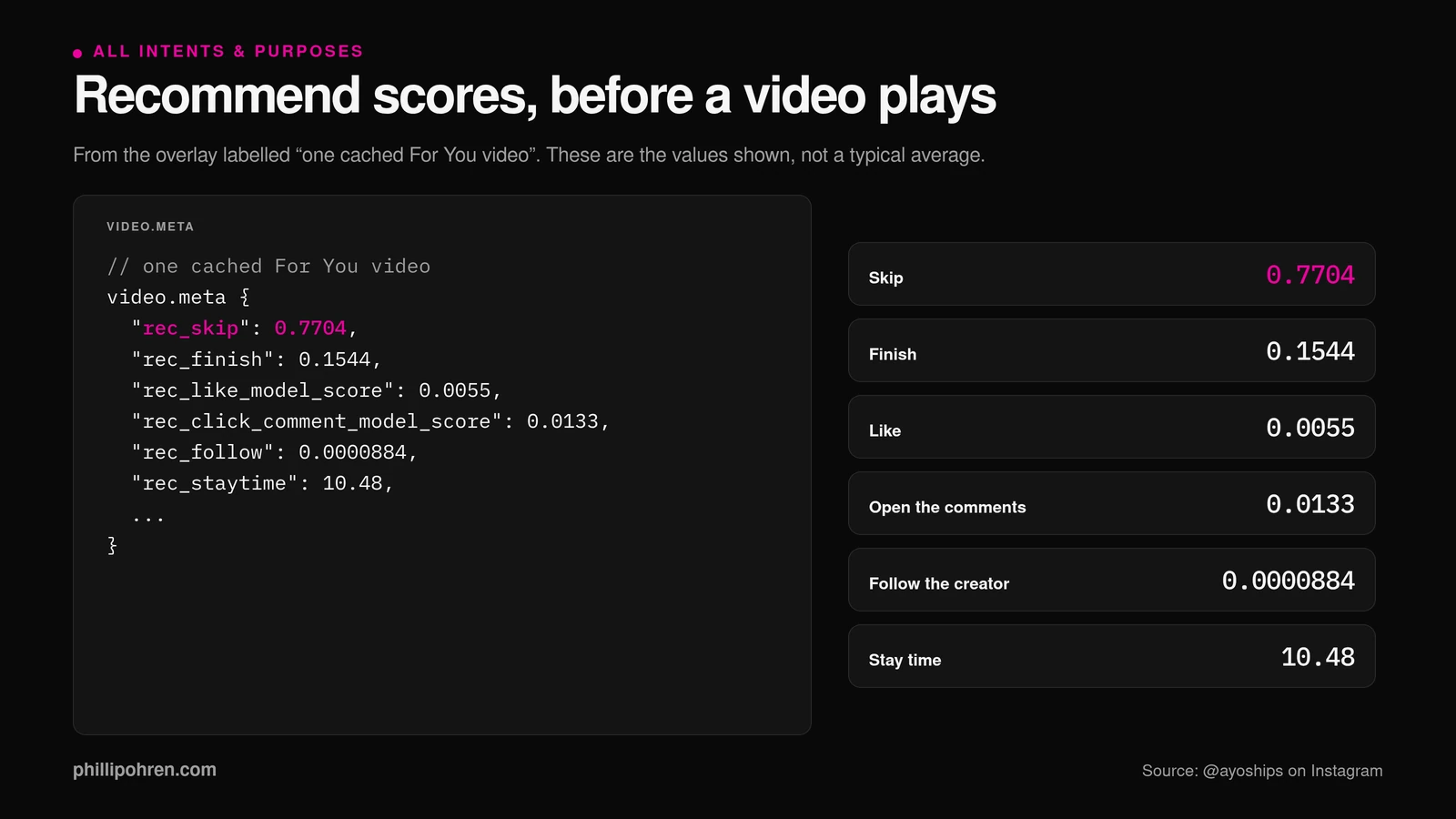
That is the same shape as what Omolewa shows. A cached For You video in the reel is already labelled with what he calls recommend scores. The example on screen reads rec_skip 0.7704, rec_finish 0.1544, rec_like_model_score 0.0055, rec_click_comment_model_score 0.0133, rec_follow 0.0000884 and rec_staytime 10.48 — figures from one video, not a typical average, and the field names are his.
The New York Times, in December 2021, reported on "TikTok Algo 101", an internal Beijing engineering document. A company spokeswoman, Hilary McQuaide, confirmed its authenticity and said it was written to explain the algorithm to non-technical employees (Ben Smith, 5 December 2021). The Times reported a simplified scoring equation:
P<sub>like</sub> × V<sub>like</sub> + P<sub>comment</sub> × V<sub>comment</sub> + E<sub>playtime</sub> × V<sub>playtime</sub> + P<sub>play</sub> × V<sub>play</sub>
and quoted the document as saying the recommender "gives scores to all the videos based on this equation, and returns to users videos with the highest scores." The same article said the company's "ultimate goal" was adding daily active users, and that it had chosen to optimise for retention and time spent.
TikTok's newsroom post, How TikTok recommends videos #ForYou, adds the weightings. A strong indicator of interest, it says, is "whether a user finishes watching a longer video from beginning to end." Device and account settings such as language, country and device type "receive lower weight." Neither follower count nor a creator's previous high-performing videos are, TikTok says, direct ranking factors.
ByteDance, TikTok's parent company, has also published Monolith, a real-time training architecture for workloads "such as short-videos ranking or online ads" (Liu et al., 2022). The paper says user behaviour drifts and that updated parameters are pushed to the serving model at a "minute-level time interval." It landed in the BytePlus Recommend product, and it does not describe TikTok's consumer app or on-device models.
Then the app adds context from the device
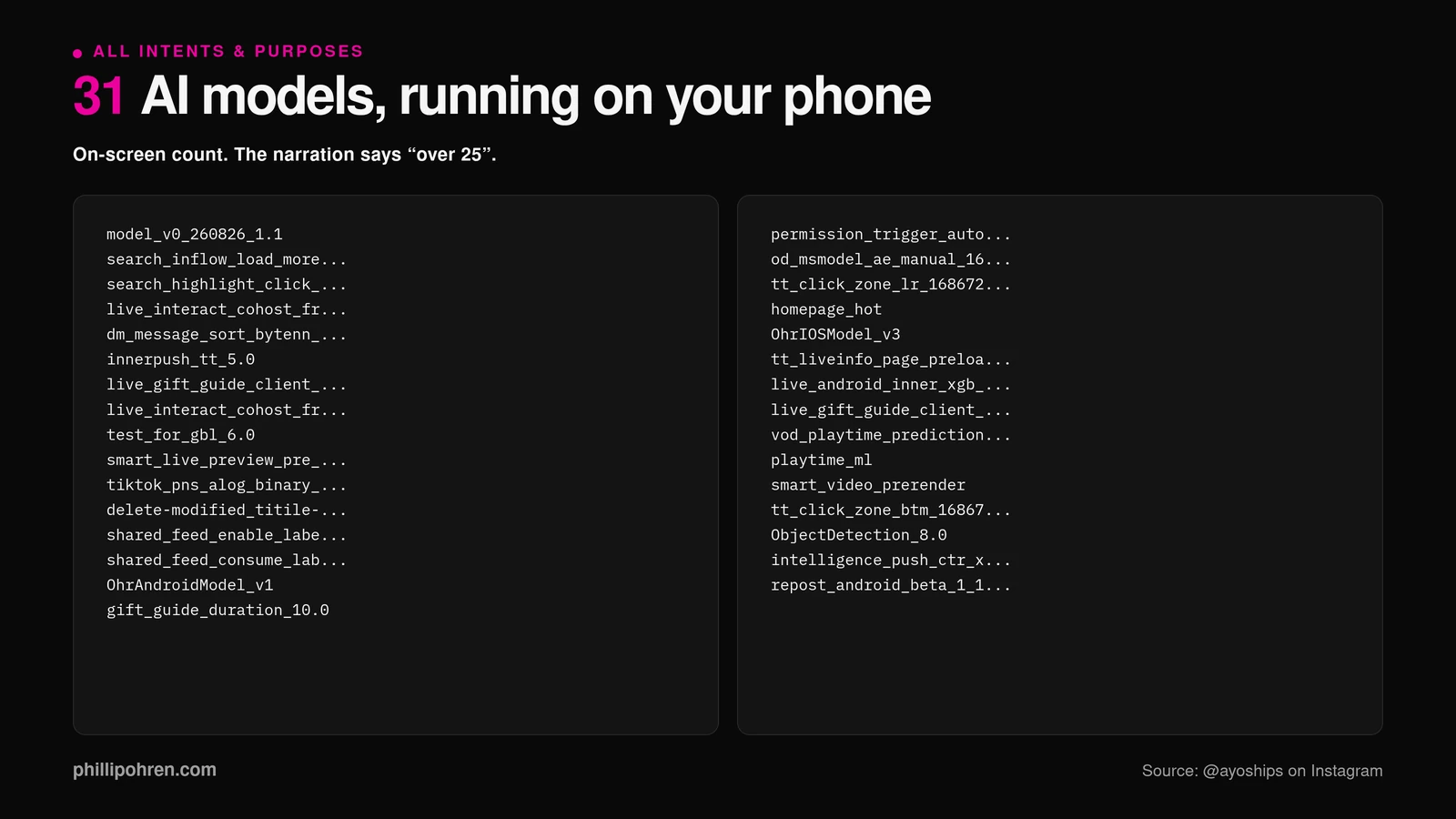
Omolewa says some of the models run on the phone, and an overlay lists 31 names (his narration says "over 25"). Several labels are truncated on screen. I have not found a TikTok publication that confirms that count, or that this list runs locally. Treat both as his finding, not a company statement.
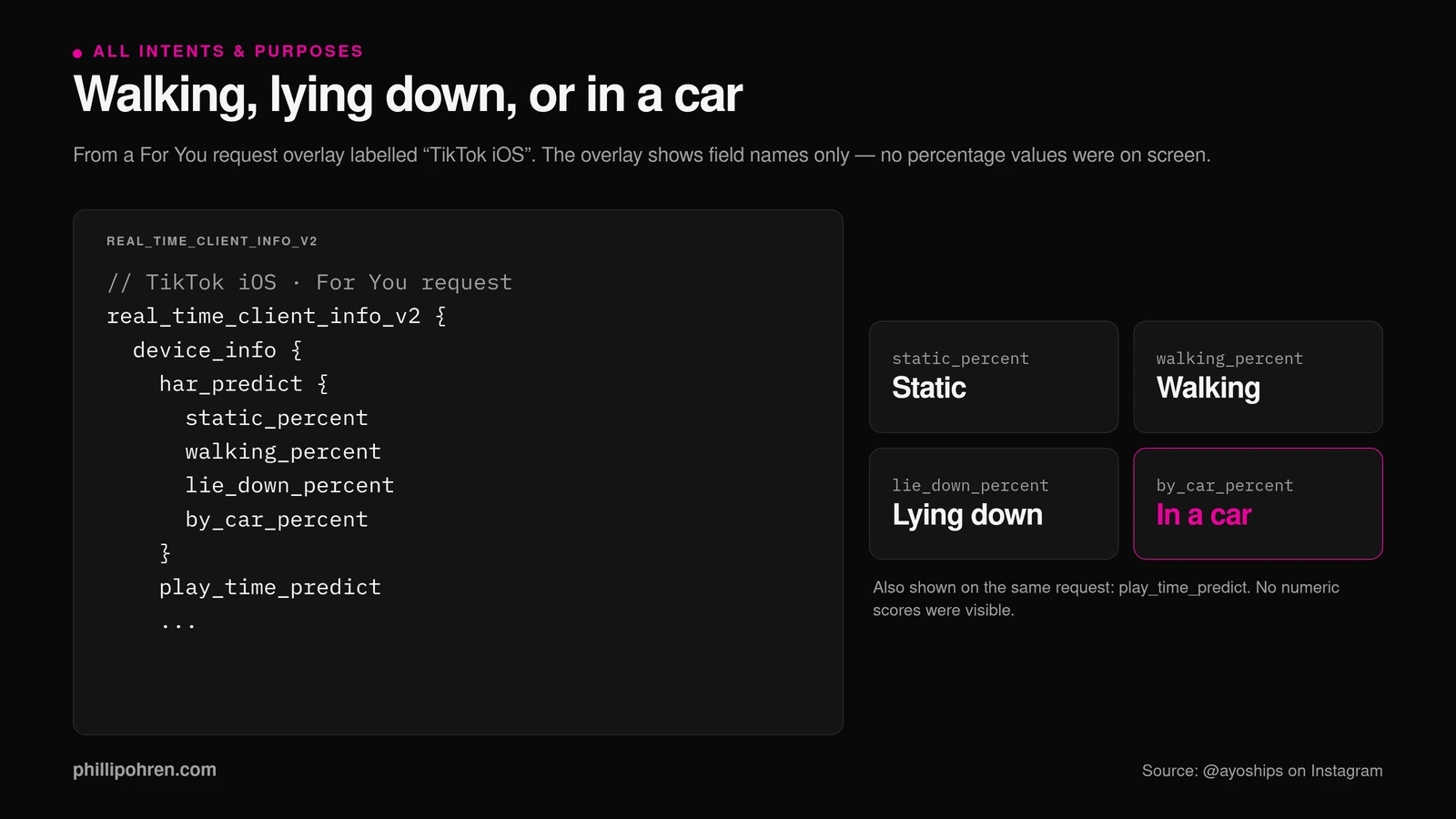
The motion overlay is more sensitive. He shows a For You request with a har_predict block — field names for static, walking, lying down and in a car, plus play_time_predict. No percentages were visible. He says a model reads the gyroscope and motion sensors to tell which state you are in. I have not found those fields in TikTok's public privacy policy or recommendation explainers.
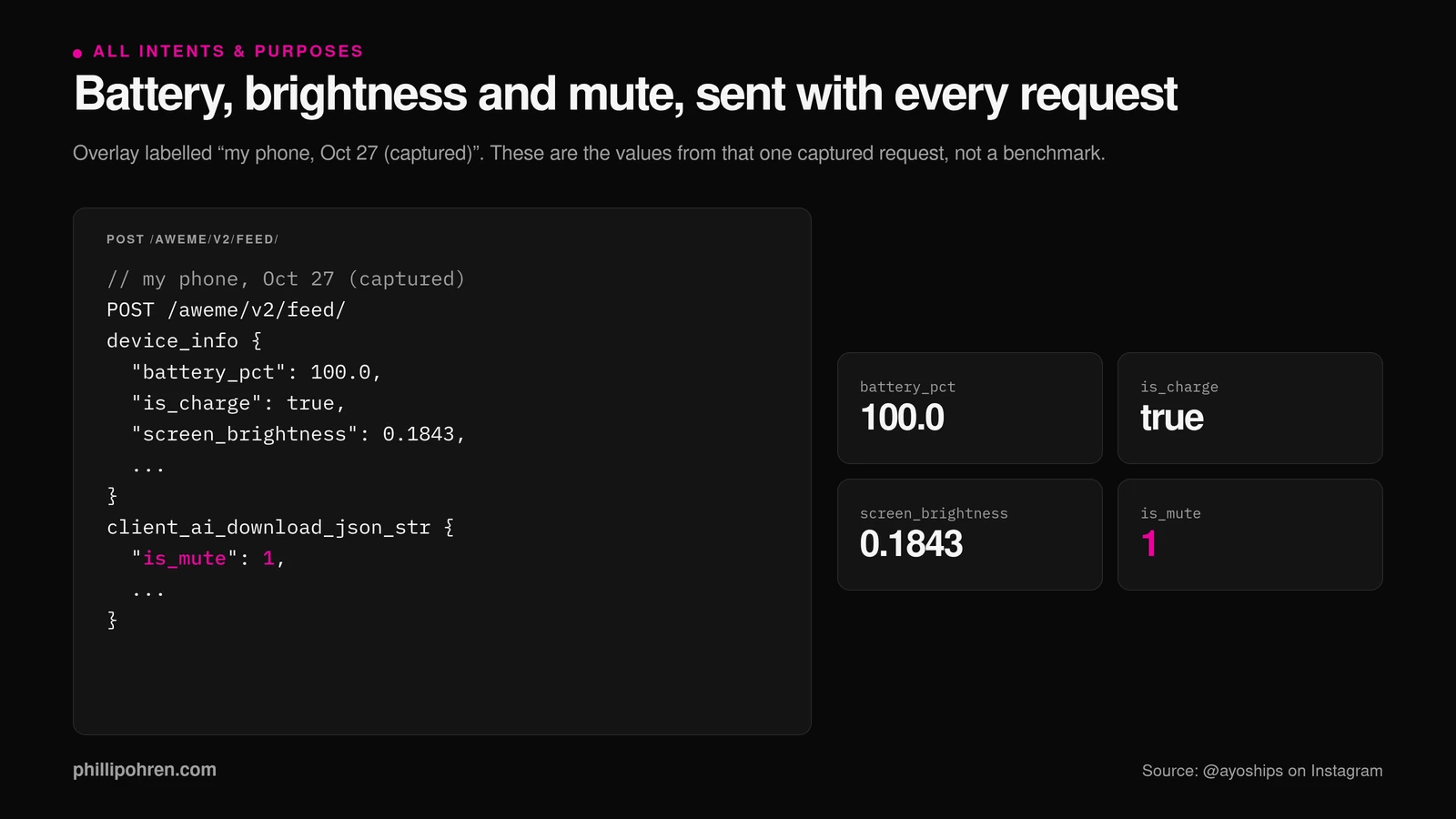
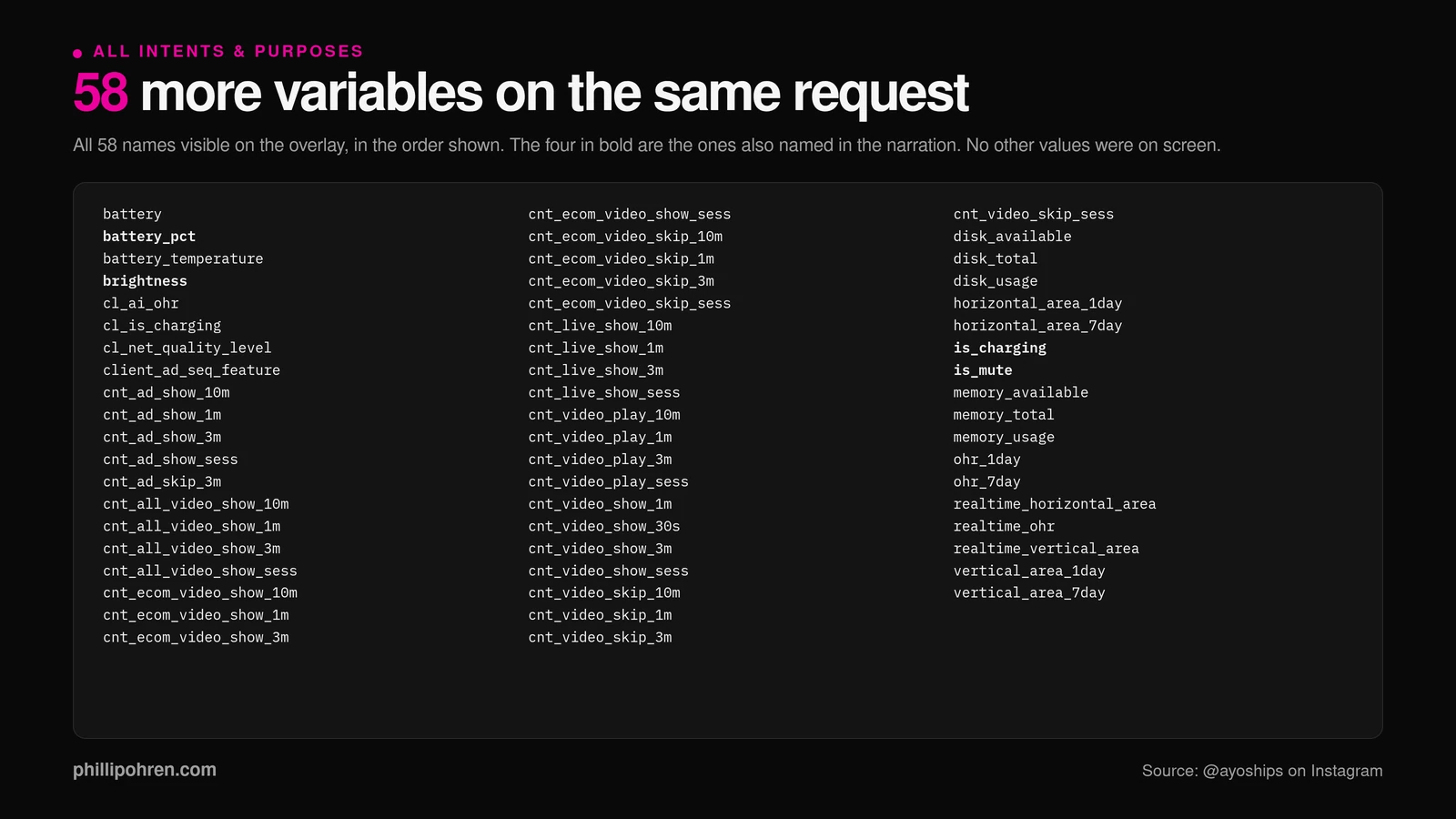
Other device signals are easier to square with the public record. In the reel, a 27 October request includes battery percentage, charging status, screen brightness and mute. TikTok's privacy policy for other regions, last updated 8 July 2025, lists technical information including "battery state, audio settings and connected audio devices," plus screen resolution and keystroke patterns or rhythms (TikTok Privacy Policy). That does not confirm this exact request. It does confirm that battery state and audio settings are data TikTok says it collects. The same walkthrough lists 58 further variable names, which official pages do not publish.
On messages, Omolewa says even a message you type and then do not send is still collected. The privacy policy says TikTok collects information you provide "when you compose, send, or receive messages," including the content and metadata. "Compose" is broader than "send." The more specific claim in the reel — that unsent drafts are passed into For You through a typing-recommendation interface — is not described in the policy I read, and I have not independently verified it.
Next, the feed is ranked for you — with a variety check
Once the scores exist, TikTok says ranking sorts videos from high to low "of the likelihood you'll enjoy the video." A similarity check then replaces top-ranked clips that are too similar — "for example, they use the same sound." The newsroom post is blunt: your For You feed "generally won't show two videos in a row made with the same sound or by the same creator." It also says the system will sometimes insert a video that does not appear relevant to your expressed interests, so you can discover new creators.
The reel's stronger claim is that every new batch is picked for "whatever state you're in" — the lunch-break feed, he says, is different from the one you get lying in bed. That leap depends on the uncorroborated motion signals. What is on the public record is narrower, and still important: the ranking is personal, updated from your interactions, and adjusted so the next clip is not a near-copy of the last one.
Then come the interventions meant to keep you there
Here the public record and the reel diverge most sharply. The Times reported that "TikTok Algo 101" described an "ultimate goal" of adding daily active users, and that the feed was being optimised for retention and time spent — a statement about the aim of the system, not about particular recovery tactics.
Omolewa describes several. He says a model predicts whether you will skip the rest of the clips already loaded, and that if it does, the phone requests an "emergency batch" to get your attention back. If you keep skipping, a stored rule in the overlay, live_pull_lost_focus_video_feed, marks you as having lost focus and, as a last resort, puts a live video into the feed. He also shows drowsiness-detection and keep-warm scheduler labels, which he says can tell if you have dozed off, and can predict when you will open the app next and start it in the background.
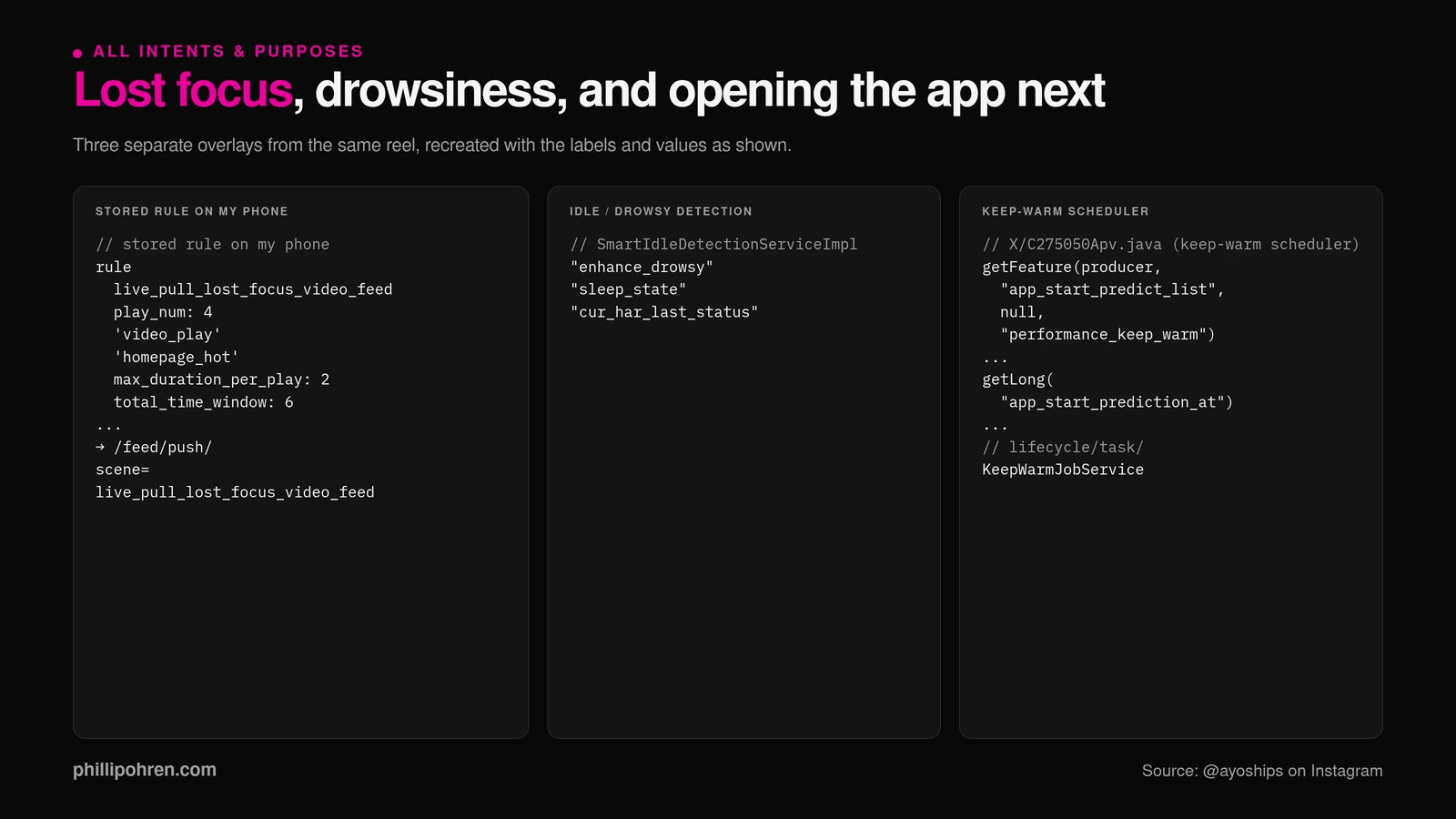
I have not found public TikTok documentation of those tactics. They remain, for now, uncorroborated.
What this means for marketers
You do not need the unconfirmed device-sensor story to change how you make ads for For You. The system is predicting skip, finish, like, comment, follow and watch time — so hook and hold are the inputs. And because TikTok generally will not serve two videos in a row with the same sound or from the same creator, a run of near-identical ads works against the ranking rules. Variety is how you stay eligible to be next.
That is the lesson I keep coming back to on Meta and elsewhere: when the algorithm does the targeting, creative is the targeting. Volume matters only if the pieces are genuinely different — a new hook, a new face, a new proof point. I measure that work as Return on Creative Spend (ROCS), alongside Return on Ad Spend. The full picture is here: ROAS + ROCS.
Make work that earns the first three seconds with the sound off, and work that deserves the full watch when the sound is on. Do not try to game battery level. Do make enough distinct creative that the system has something new to test.
Overlays recreated from Omolewa's reel, 3 November 2026, 3:52pm UTC (4 November, 2:52am AEDT). Source: @ayoships on Instagram.
About the author: Phil Ohren is founder and CEO of Intender, an Australian intent marketing agency. Over 24 years he has advised 214 clients and influenced $628M+ in client revenue. He coined Return on Creative Spend (ROCS) to give marketers the missing half of their return on investment: the part of advertising customers actually see. More from Phil at phillipohren.com.